The Emirati Scene
April 22, 2026 – May 25, 2026
Iyad Qanazea Gallery Presents The Emirati Scene
The Emirati Scene at Iyad Qanazea Gallery presents a group exhibition that celebrates the depth, diversity, and evolution of artistic expression in the United Arab Emirates.
Bringing together a multigenerational group of artists from within the Emirates, the exhibition offers a vivid representation of the country’s creative landscape, one shaped by civic-ness, identity, openness, and a bold contemporary vision.
Through painting, sculpture, mixed media, and conceptual works, The Emirati Scene highlights the unique voices that continue to define and expand the UAE’s cultural narrative.
More than a survey of contemporary Emirati art, this exhibition is an act of civic ideation.
The works gathered here move between the personal and the collective, the rooted and the expansive. Each artist engages with the UAE not merely as geography
or backdrop, but as a living, contested, deeply felt civic space long alive in their sense of home, interrogation, and imagination.
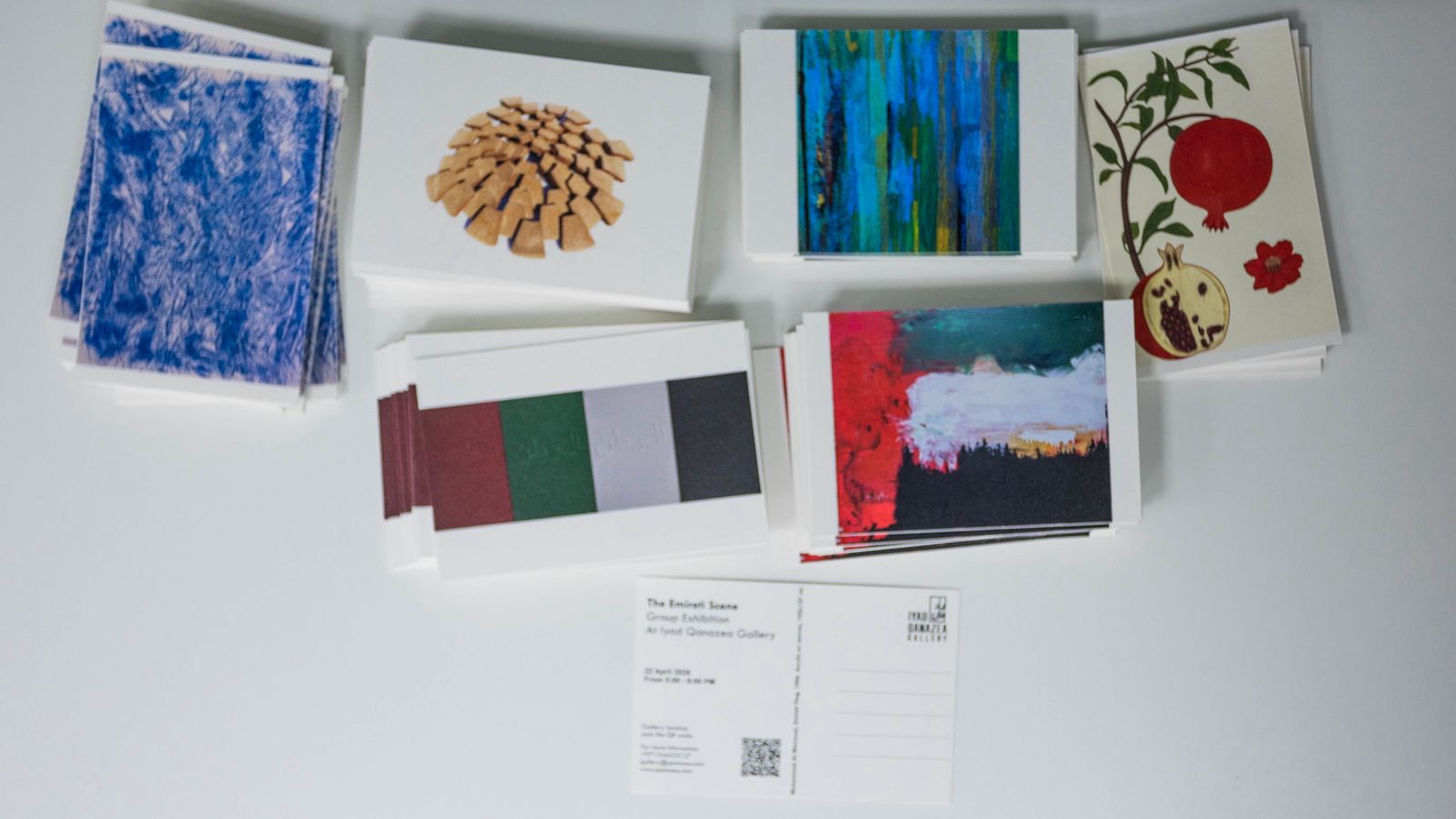
A central work in the exhibition is Mohammed Al Mazrouei’s Emirati Flag (1996), an acrylic painting that situates itself firmly within the expressionist tradition while remaining distinctly grounded in its subject. The flag one of the most legible symbols of collective identity is not deconstructed here but inhabited: rendered through a painterly intensity that treats national belonging as something felt in the body before it is understood in the mind.
Across painting, sculpture, mixed media, and conceptual practice, these artists share a quality of expansiveness a willingness to hold complexity without resolving it into sentiment.
The abstract and the minimal become, in this context, not gestures of withdrawal but of ambition: a belief that art can carry more than it states, that silence
and reduction can be as consequential as declaration.
There is something distinctly forward-looking in this vision of artistic identity that is neither nostalgic nor derivative but self-determined and open to the world on its own terms.
Participating Artists
Mahra Al Falahi
Al Falahi’s practice centers on sustained research into indigenous plant life as a framework for investigating identity, knowledge systems, and the relationship between land and cultural memory. Her works approach botanical subjects.
matter analytically, situating local flora within broader questions of what is preserved, what is lost, and what continues to grow at the margins of rapid environmental and social change.
Mohammed Al Mazrouei
Al Mazrouei’s paintings operate within an expressionist and existentialist register, employing bold, instinct-driven mark-making to engage questions
of identity, ambiguity, and the human condition. His canvases resist resolution, sustaining a tension between gesture and meaning across an interdisciplinary practice that spans painting, writing, and performance.
Azza Al Qubaisi
Al Qubaisi’s metal sculptures engage processes of forging, weathering, and structural tension to produce forms that carry cultural memory.
Working with metal as both material and language, her works occupy space with deliberate authority objects shaped by force and time, positioned within Emirati
contemporary art’s engagement with materiality and collective identity.
Cristiana De Marchi
De Marchi’s Home embroidery works engage needlework as both medium and conceptual framework, examining domesticity, displacement, and the idea of place as something constructed through repetitive, intimate acts.
The works sit within a lineage of feminist material practice while extending toward questions of belonging, migration, and home as physical and psychological space.
Mohammed Kazem
Kazem’s Scratches series is produced through systematic marking, scratching directly onto surfaces with controlled, repeated gestures, situating the works at the intersection of drawing, performance, and durational practice.
The scratch becomes a unit of measurement: of time, of presence, of the body’s relationship to surface, accumulating into a record of sustained attention.
Najat Makki
Makki’s abstract paintings are characterized by bold, saturated color fields and a gestural vocabulary in dialogue with mid-twentieth century abstraction
while remaining attentive to the chromatic and spatial qualities of the Gulf landscape.
Her practice develops a painterly syntax that is emotionally direct and formally considered a sustained engagement with abstraction as a language for place and
experience.